
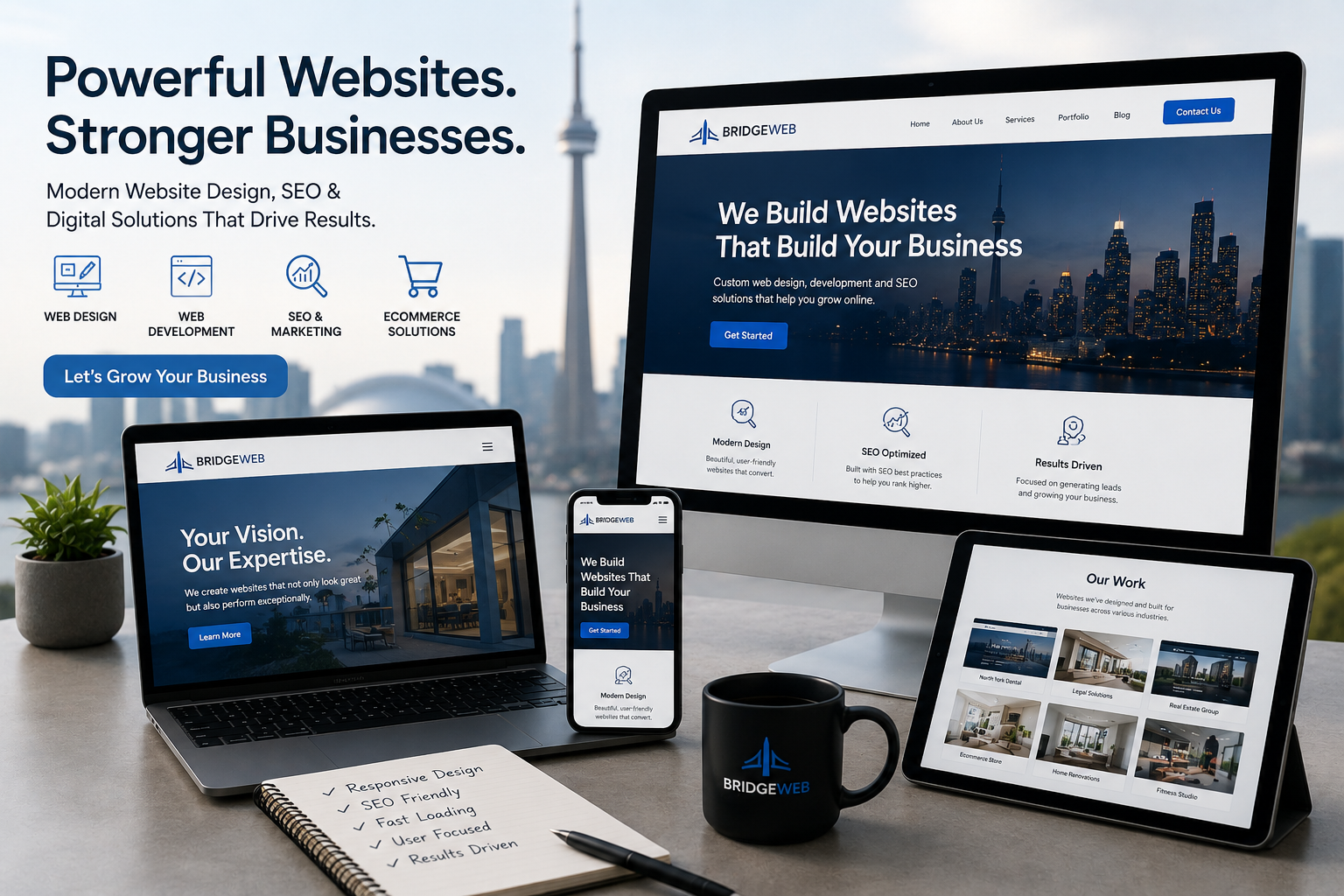
Summary: If you run a small business in Toronto, showing up in Google is no longer just about ranking a homepage and hoping for the best. In 2026, your website needs to be clear, useful, technically sound, and built around what real customers are searching for. It also needs to be strong enough to earn visibility in newer search experiences like AI Overviews. In this guide, we break down what that actually means, what small businesses usually get wrong, and what to focus on if you want your website to bring in more relevant traffic and better leads.
Jump To:
- Why This Matters in 2026
- What Google Actually Wants From Your Website
- How AI Overviews Change SEO for Small Businesses
- What Toronto Small Businesses Should Focus On
- Common SEO Mistakes That Hold Websites Back
- How to Prioritize SEO Work Without Wasting Time
- Final Thoughts
SEO advice gets noisy fast. One person says publish more blog posts. Another says fix technical SEO. Someone else says AI has changed everything. For a small business owner, that usually leads to the same problem: too much advice, not enough clarity.
The better starting point is simpler than most people think. Your website needs to help the right person understand what you do, where you work, why they should trust you, and what to do next. That was true before AI Overviews, and it is still true now. The difference is that Google is getting better at surfacing the pages that answer questions clearly and helpfully, not just the ones that repeat keywords the most. Google’s own documentation continues to emphasize helpful, reliable, people-first content, and its SEO Starter Guide says SEO is about helping search engines understand your content while helping users decide whether they should visit your site. :contentReference[oaicite:1]{index=1}
For Toronto small businesses, this matters because local competition is real. If you are a contractor, clinic, law firm, accountant, home service company, retailer, or any service-based business in Toronto, Etobicoke, or Etobicoke, your website often shapes the first serious impression someone gets of your company. A weak site can quietly lose you leads. A strong one can keep working for you every day.
Why This Matters in 2026
Search is not standing still. Google has continued expanding AI-driven search experiences, and two days ago it published a new guide specifically for optimizing websites for generative AI features in Google Search. That matters because it confirms something many businesses were already suspecting: websites now need to be built not only for classic blue-link rankings, but also for newer search experiences that summarize and synthesize information for users. :contentReference[oaicite:2]{index=2}
That does not mean small businesses need to panic and rebuild everything around AI. Google’s guidance is still consistent at the core. Create useful pages. Make them easy to understand. Give people original value. Structure your site well. Let Google access your content. Help users accomplish what they came for. Those principles remain central across Google’s helpful content guidance, SEO Starter Guide, and its newer AI optimization documentation. :contentReference[oaicite:3]{index=3}
For small businesses, the real opportunity is not chasing every new SEO trend. It is strengthening the parts of the website that should have been strong already.
What Google Actually Wants From Your Website
A lot of SEO advice makes it sound like Google is looking for tricks. It is not. Google says its ranking systems are designed to show helpful, reliable information created to benefit people, not content made mainly to manipulate rankings. It also says the focus is on the quality of content rather than whether AI was used in producing it. :contentReference[oaicite:4]{index=4}
That leads to a practical question: what does a helpful small business website actually look like?
It answers real questions clearly
If someone lands on your site, they should not have to guess what you do. Good service pages explain the service, who it is for, what areas you serve, what makes your approach different, and how someone can take the next step.
It is built around real search intent
A page should match the kind of question the searcher has. Someone searching for a web design company in Etobicoke wants something different from someone searching for how much a business website costs in Toronto. One search is local commercial intent. The other is informational and commercial investigation. Good SEO respects that difference.
It has a strong site structure
Your pages should be organized logically. Services should have their own pages when it makes sense. Internal links should help people move from broad topics to more specific ones. This is one reason many businesses benefit from custom web design instead of relying only on a thin template site with vague page structure.
It gives people enough detail to trust you
Thin pages are a common problem. Many local business websites say almost nothing beyond a headline, a paragraph, and a contact form. That is usually not enough. People want reassurance. They want specifics. They want to know if you actually fit what they need.
It works well on mobile
Google’s SEO guidance has long stressed making sites useful for visitors, and in practice that means mobile usability is essential for local businesses. A site that is technically responsive but frustrating on a phone still creates friction. This is where mobile website design matters because a large share of local searches happen on mobile devices. :contentReference[oaicite:5]{index=5}
How AI Overviews Change SEO for Small Businesses
The biggest mistake businesses make with AI Overviews is assuming they need a completely different kind of content. In reality, Google’s new AI optimization guide points site owners back toward many of the same fundamentals: crawlable pages, strong content, helpful information architecture, and content that is genuinely useful for users. :contentReference[oaicite:6]{index=6}
What does change is the importance of being clear and quotable. If your page rambles, hides key answers, or fills space with generic filler, it becomes less useful in both classic search and AI-driven search experiences. Pages that explain things cleanly, answer likely follow-up questions, and stay focused on the topic are in a better position.
For small businesses, that means your content should do a few things well:
- Answer the main question early
- Explain the topic in plain language
- Add useful specifics instead of vague claims
- Use headings that make the page easy to scan
- Support the answer with relevant examples or practical guidance
This is also why random AI-generated filler is a bad strategy. Google has said using automation, including AI, is not inherently against its guidelines, but content quality remains the key issue. If the result is generic, repetitive, or unhelpful, it is still weak content. :contentReference[oaicite:7]{index=7}
What Toronto Small Businesses Should Focus On
If you want better visibility in Google Search and AI Overviews, focus on the parts of SEO that actually move the needle for a local business.
1. Build strong service pages
For most service businesses, the service pages matter more than the blog. Your site should have clear, well-developed pages for the main services you want to be found for. If you offer website design, ecommerce design, SEO, branding, UX/UI, or web development, those should not be squeezed into one vague page. They should be structured properly so both users and search engines can understand them.
This is where pages like SEO services, ecommerce web design, and UX/UI design naturally support a stronger website architecture when they are genuinely relevant to the business.
2. Make your local relevance obvious
If you serve Toronto, say so clearly. If you work in Etobicoke or Etobicoke, mention that where appropriate. Your service areas should make sense in the content, not be stuffed awkwardly into every paragraph.
Google also continues to connect many businesses with customers through Business Profiles, including businesses without websites, but having a website still gives you much more control over how your services, trust signals, and detailed information are presented. :contentReference[oaicite:8]{index=8}
3. Write content people would actually bookmark
Most business blogs are too shallow. They cover broad topics with generic advice and no real perspective. Helpful content is more specific. It addresses the actual decision a business owner is trying to make. It gives context. It explains trade-offs. It does not hide behind buzzwords.
That is why useful topics often outperform generic ones. Instead of writing “What Is SEO?” a local business may get more value from a post like “How Toronto Small Businesses Can Show Up in Google Search and AI Overviews in 2026” because it meets a more specific need.
4. Improve user experience, not just keywords
SEO and user experience are not separate. If users cannot find what they need, do not trust the content, or feel lost on the page, the website is weaker. Better UX/UI design can improve how people move through the site, which supports both engagement and conversions.
5. Keep technical basics in good shape
You do not need enterprise-level technical SEO to compete locally, but you do need the basics handled well. Crawlable pages, working internal links, sensible title elements, clean headings, mobile usability, and decent performance still matter. Google’s SEO Starter Guide continues to frame SEO around helping search engines understand your content and helping users decide whether to visit your site. :contentReference[oaicite:9]{index=9}
Common SEO Mistakes That Hold Websites Back
Small businesses often do not fail at SEO because they ignored it completely. They fail because they invest in the wrong things first.
Publishing weak blog content
More posts do not automatically mean better SEO. Ten generic articles can do less for your business than two strong ones that address real local or commercial questions properly.
Stuffing location names everywhere
Saying “Toronto” twenty times on a page does not make it good local SEO. It just makes the content awkward. Local relevance should feel natural, not forced.
Combining every service onto one page
If everything is crammed into one general page, it becomes harder for users and search engines to understand the business clearly. Good page separation helps both.
Ignoring content quality because AI makes publishing easy
Automation can speed up drafting, but Google’s guidance remains clear that helpful, reliable content is the goal. Fast content is not the same as useful content. :contentReference[oaicite:10]{index=10}
Waiting too long to improve the website itself
Some businesses try to solve everything with content while leaving the site slow, thin, poorly structured, or hard to use. Often the better move is to improve the core website first.
How to Prioritize SEO Work Without Wasting Time
If your website needs work, do not try to fix everything at once. Start with what will actually matter for a small business.
- First, strengthen the main service pages.
- Then improve local relevance and internal linking.
- After that, publish a few genuinely useful blog posts tied to real search intent.
- Then review mobile usability, conversion flow, and technical basics.
That order is more practical than jumping straight into high-volume publishing or buying backlinks without a strong website underneath. For many businesses, the best SEO gains come from better structure, better messaging, and better service pages before anything more advanced.
If the site itself is holding you back, it may make sense to improve the foundation first through stronger design, better content structure, or even custom web development when the current setup is too limited.
Final Thoughts
If you want your Toronto business to show up more often in Google Search and AI Overviews in 2026, the answer is not chasing tricks. It is building a website that is clearer, more useful, and more aligned with what real customers need.
Google’s own guidance still points in the same direction: helpful content, strong site quality, clear structure, and content built for people first. The newer AI optimization guidance does not replace those fundamentals. It reinforces them. :contentReference[oaicite:11]{index=11}
For small businesses, that is actually good news. You do not need a gimmick. You need a website that explains your services well, supports trust, works on mobile, and gives search engines enough clarity to understand what your business offers.
If you want help building a stronger website and SEO foundation, you can contact BridgeWeb to talk about the right approach for your business, your market, and your growth goals.

