
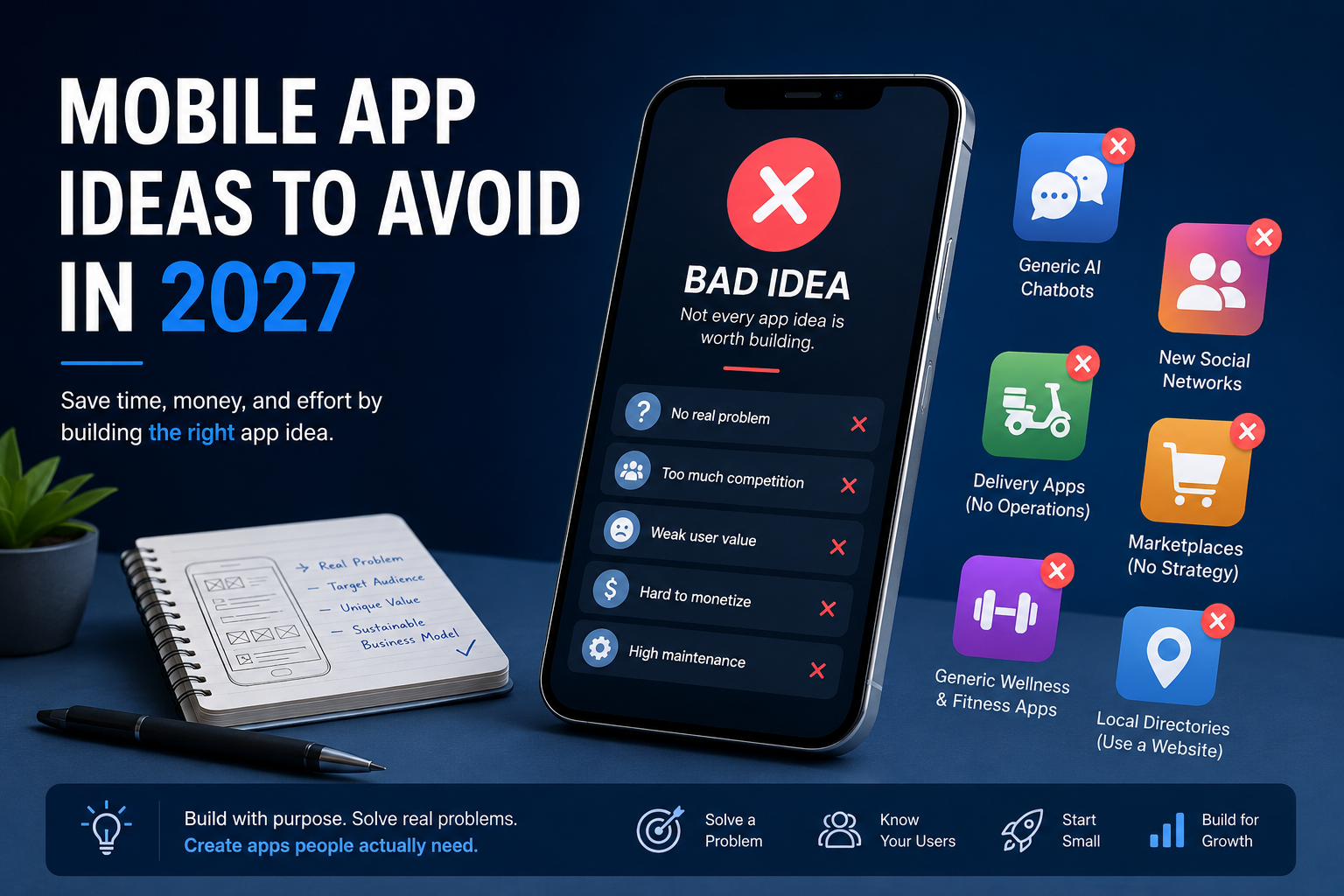
Summary: Not every app idea is worth building. In 2027, the mobile app market will be harder, more competitive, and more affected by AI assistants than ever before. For Toronto entrepreneurs and small businesses, the smartest move is not simply building an app because the idea sounds exciting. It is knowing what app ideas to avoid, what problems are already solved, and where real business value still exists. In this guide, we explain which mobile app ideas are risky, why many apps fail, and how to choose a stronger direction before investing in development.
Jump To:
- Why This Matters in 2027
- 1. Copycat Apps With No Clear Difference
- 2. Generic AI Chatbot Apps
- 3. New Social Network Apps Without a Real Community
- 4. Delivery Apps Without Operations Behind Them
- 5. Marketplace Apps With No Supply or Demand Strategy
- 6. Generic Fitness, Wellness, and Habit Apps
- 7. Local Directory Apps That Should Be Websites
- What to Build Instead
- A Quick Decision Checklist
- Final Thoughts
Many people start with the same sentence: “I have an app idea.” That can be exciting, but it can also be dangerous if the idea has not been tested. An app can be expensive to design, develop, launch, maintain, market, and improve. If the idea is weak, the app will not become stronger just because it looks professional.
For businesses in Toronto, this matters even more. The market is crowded, customers are busy, and people already have too many apps on their phones. A new app has to earn space in someone’s daily life. If it does not save time, make money, reduce stress, improve convenience, or solve a real problem, it will probably be ignored.
By 2027, the pressure will be even higher. Gartner has predicted that mobile app usage may decrease because users will rely more on AI assistants to complete tasks. That does not mean apps are dead. It means weak apps, generic apps, and apps that do not offer a strong reason to return will have a harder time surviving. Gartner’s prediction about mobile app usage is a reminder that businesses need to be more selective before building.
Why This Matters in 2027
In the past, building an app felt like a major competitive advantage. Today, it is not enough. The question is not “Can we build this?” The better question is “Will people use this often enough to justify building it?”
A lot of app ideas sound useful in a meeting. The problem shows up later, when real users do not download the app, do not return after the first use, or refuse to pay for it. That is usually not a development problem. It is a product strategy problem.
App stores are also becoming stricter. Google said it prevented more than 1.75 million policy-violating apps from being published on Google Play in 2025, which shows how much pressure there is around app quality, safety, and compliance. If your idea is thin, repetitive, misleading, or low value, it may not just struggle with users. It may also struggle with platform expectations. Google’s update on Play Store safety shows how seriously app quality is being treated.
That is why choosing what not to build is just as important as choosing what to build.
1. Copycat Apps With No Clear Difference
One of the riskiest app ideas to avoid in 2027 is the copycat app. This is the app that sounds like “Uber, but for this,” “TikTok, but for that,” or “Airbnb, but for another niche.” Sometimes those ideas can work, but only if there is a real market gap and a strong execution plan. Most of the time, the idea is too shallow.
Users do not switch apps just because a new option exists. They switch because the new option solves a pain point much better than the current one. If your app is almost the same as something people already use, you need a very strong reason for them to change their behaviour.
A copycat app is especially risky because the original company usually has more users, more trust, more data, more funding, and better brand recognition. Competing directly with that is expensive.
Instead of copying a big app, look for a smaller problem inside a specific market. For example, rather than building a general booking app, a Toronto clinic might need a custom patient intake and appointment workflow. That kind of project is more focused and more useful than trying to compete with large platforms.
2. Generic AI Chatbot Apps
AI will still be huge in 2027, but that does not mean every AI app idea is strong. A generic chatbot app is one of the easiest ideas to come up with and one of the hardest to make valuable.
If your idea is simply “an AI app that answers questions,” it is probably not enough. Users already have access to major AI tools. To compete, your app needs a specific use case, a clear workflow, trusted data, privacy protection, and a reason to use your product instead of a larger AI platform.
A better AI app is not just a chatbot. It is a tool that fits into a real process. For example, an AI assistant for a specific business workflow may be useful if it helps staff save time, reduce errors, prepare documents, manage customer requests, or automate repeated internal tasks.
The key is specificity. “AI for everyone” is usually too broad. “AI to help a property management company process maintenance requests faster” is much stronger.
If your app idea involves AI, it may need deeper planning through custom web development or mobile app development rather than a quick generic build.
3. New Social Network Apps Without a Real Community
Many founders still dream about creating the next big social platform. The problem is that social apps are extremely hard to grow because they need users before they are useful. If nobody is there, nobody stays.
A new social app without a clear community strategy is one of the riskiest app ideas to build. It usually requires strong network effects, constant engagement, content moderation, privacy controls, safety features, and a serious marketing budget.
The idea may sound simple: people create profiles, post content, follow each other, and message. But the real challenge is not the feature list. The real challenge is creating a reason for people to spend time there instead of on the platforms they already use.
If the social element is part of a more specific business model, it can make sense. For example, a private community app for paid members, students, patients, clients, or professionals may work because the audience already has a shared reason to participate. But building a broad public social network from scratch is usually not a smart first move.
4. Delivery Apps Without Operations Behind Them
A delivery app sounds straightforward from the outside. Users order, drivers deliver, businesses get paid. In reality, delivery apps are operational businesses with technology attached. The app is not the hard part by itself. The hard part is logistics.
You need drivers, routes, support, refunds, payments, service areas, timing, merchant relationships, and customer trust. If those pieces are not planned, the app will fail no matter how clean the design looks.
For Toronto, this is especially important because customers already have strong expectations around speed and convenience. If your app promises fast delivery but cannot deliver reliably, users will not give it many chances.
Instead of building a general delivery platform, consider a more focused solution. A business may need an internal delivery management tool, a booking system, or a customer portal. That can be more realistic than trying to create a full delivery marketplace.
5. Marketplace Apps With No Supply or Demand Strategy
Marketplace apps can be powerful, but they are difficult. The classic problem is simple: buyers will not use the app if there are no sellers, and sellers will not join if there are no buyers.
Many marketplace ideas fail because the founder thinks the app itself creates the market. It does not. The app supports the market after the demand and supply strategy are clear.
Examples include apps for local services, freelancers, rentals, tutoring, beauty appointments, trades, events, or professional connections. These can work, but only when there is a strong plan for how one side of the marketplace will be built first.
If you want to build a marketplace in Toronto, start smaller. Choose a niche, a neighbourhood, a specific service category, or a controlled group of vendors. Prove the transaction manually before building the full platform. If people will not use the idea manually, they probably will not use it just because it has an app.
A marketplace often needs strong UX/UI design because trust, filtering, profiles, reviews, messaging, and checkout all affect whether users feel comfortable completing a transaction.
6. Generic Fitness, Wellness, and Habit Apps
Fitness and wellness apps are popular, but the market is crowded. A generic habit tracker, meditation app, workout planner, calorie tracker, or wellness reminder app is difficult to grow unless it has a very specific angle.
People already have plenty of options. Many are free. Many are backed by major brands. Many are built into devices, watches, and health platforms. That makes it hard for a new app to stand out.
The mistake is thinking that because people care about health, they will download another health app. They may not. Users need a clear reason to choose your version.
A better approach is to focus on a specific audience or real-world service. For example, a physiotherapy clinic might build a patient exercise tracking system connected to treatment plans. A personal training business might build a member portal for paid clients. A wellness provider might create a booking and resource hub that supports an existing service.
The idea becomes stronger when the app supports a real business relationship instead of trying to become another general wellness tool.
7. Local Directory Apps That Should Be Websites
Another app idea to avoid in 2027 is a basic local directory app. These are apps that list businesses, restaurants, events, service providers, or neighbourhood resources without offering much beyond search and categories.
In many cases, this should not be an app at all. It should be a website.
Users are unlikely to download a separate app just to browse information they can find through Google, maps, social media, or an existing directory. A mobile-friendly website may be faster, cheaper, easier to rank, and easier to share.
This is especially true for local content. If the goal is discovery through search, a strong website with useful pages may be a better first step than an app. Through mobile website design, a business can still create a strong phone-friendly experience without forcing users to install anything.
An app makes more sense only if users need repeated access, saved accounts, notifications, payments, bookings, or personalized features. If the app is just information, think carefully before building it.
What to Build Instead
The best app ideas in 2027 will not just be trendy. They will be useful. They will solve specific problems for specific people.
For Toronto businesses, stronger ideas often fall into these categories:
- Apps that improve an existing business process
- Customer portals for bookings, payments, documents, or service updates
- Industry-specific tools for teams or clients
- Ecommerce apps connected to a real product business
- Membership apps for communities that already exist
- Internal apps that save staff time or reduce manual work
- AI-powered tools built around a specific workflow
These ideas are stronger because they are not based only on downloads. They are based on business value. They either make the company more efficient, improve customer experience, support revenue, or give users a reason to return.
In many cases, the right starting point may not be a full app. It may be a website, web app, landing page, or customer portal. BridgeWeb offers custom web design, custom web development, and mobile app development, which means the right platform can be chosen based on the idea instead of forcing everything into an app.
A Quick Decision Checklist
Before building any app in 2027, ask these questions:
- Does this solve a real problem people already care about?
- Would users open this more than once?
- Is an app truly needed, or would a mobile-friendly website work better?
- What is the revenue model?
- Who is the first specific audience?
- How will we get the first 100 users?
- What feature is essential for version one?
- What can wait until later?
If the answers are unclear, do not rush into development. A short discovery phase can save thousands of dollars and months of wasted work.
Final Thoughts
The mobile app ideas to avoid in 2027 are not always bad ideas forever. Some are simply bad starting points. A social app may work if there is already a strong community. A marketplace may work if supply and demand are planned properly. An AI app may work if it solves a specific workflow. A wellness app may work if it supports a real service or audience.
The danger is building something broad, generic, or trendy without a clear reason for people to use it repeatedly.
For Toronto entrepreneurs and small businesses, the smartest app strategy is simple: solve a real problem, start focused, validate demand, and choose the right platform. Sometimes that will be a mobile app. Sometimes it will be a web app. Sometimes it will be a better website first.
If you are planning an app idea and want to understand whether it is worth building, you can contact BridgeWeb to discuss the idea, the business model, and the best development path before you invest in the wrong version.

